|
Programming Taskbook |
|
|
||
|
Electronic problem book on programming |
||||
|
© M. E. Abramyan (Southern Federal University, Shenzhen MSU-BIT University), 1998–2026 |


|
|
Download Programming Taskbook for STL - Version 1.2 (English and Russian) OverviewThe software complex "Electronic Problem Book on the C++ Standard Template Library Programming Taskbook for STL" (PT for STL) contains additional components of the Programming Taskbook electronic problem book, which allow performing tasks related to the study of the C++ Standard Template Library (STL). To use this complex, it must be installed into the system directory of the base version of the Programming Taskbook electronic problem book, version 4.15 or higher (usually the system directory of the problem book is C:\Program Files\PT4 or C:\Program Files (x86)\PT4). The PT for STL complex is a freeware software product; it can be used both with the full version PT4Complete and with the freely distributed mini-version PT4Mini. Version 1.1 fixes noticed inaccuracies in the program templates, and also adds the ability to select the interface language for the installer program. Version 1.2 adds full English interface support: when performing tasks, you can use task descriptions in both Russian and English. The PT for STL problem book includes 300 training tasks, divided into seven groups:
Groups with a large number of tasks are divided into subgroups. The STL2Seq group contains the following subgroups (the number of tasks in the subgroup is indicated in parentheses):
The STL3Alg group contains the following subgroups:
The STL5Assoc group contains the following subgroups:
The STL7Mix group contains the following subgroups:
Tasks can be performed in C++ programming environments supported by the base Programming Taskbook. The PT for STL problem book provides the same capabilities when performing tasks as the base Programming Taskbook; in particular, it passes initial data to the student's program, checks the correctness of the results obtained by the program, and saves information about each test run of the program in a special file. Furthermore, PT for STL can use additional tools for input, output, and debug output of sequences (these tools were added to the C++ version of the problem book in version 4.15):
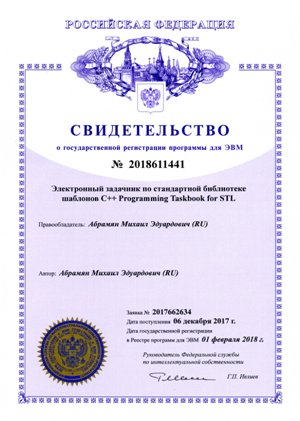
A detailed description of the properties of the iterators PT for STL actively uses add-on files, a feature that appeared in version 4.14 of the base electronic problem book. Thanks to the use of add-on files, for most training tasks individual program templates are generated, including the description of the required sequences and statements providing their input-output and debug output. The software complex "Electronic Problem Book on the C++ Standard Template Library Programming Taskbook for STL" was registered in the Register of Computer Programs on February 1, 2018 (certificate of state registration of the computer program number 2018611441).
|

|
|
Designed by M. E. Abramyan
and V. N. Braguilevsky |
Last revised: |